South of the Pipeline
A Keystone XL revival reignites a decades old oil fight
Story by Maxwell Johnson | Photos by Diego Rey
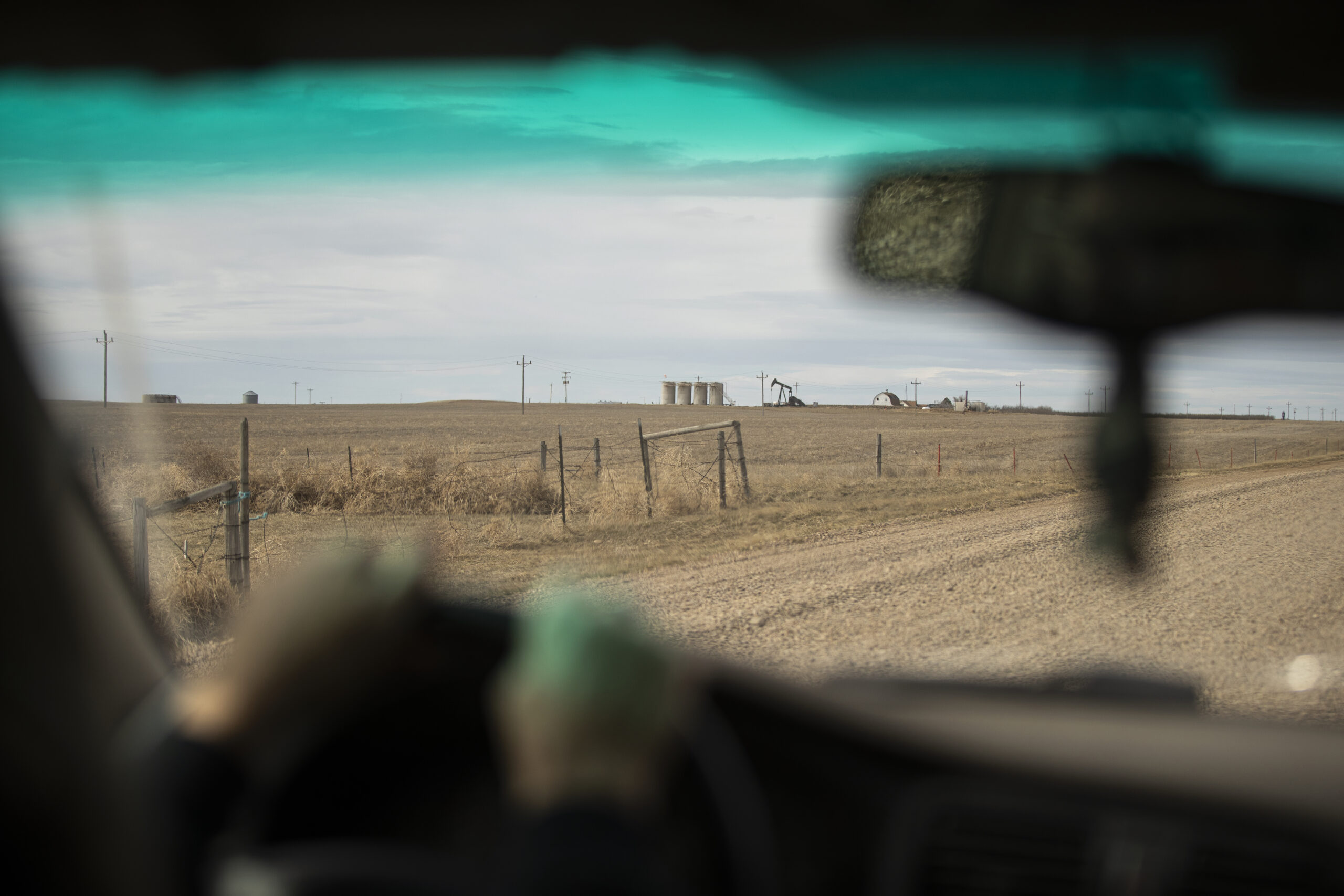
On a warm day in March, 13 miles down a gravel road, Deb Madison shepherded the oil wells of the North Poplar field through another, hopefully full, 80-hour work week.
The steady plink of gravel intensified as her Subaru crested the hill to check another pump jack. Her voice trailed off. There was a pool of black water forming 20 feet from the next jack. Several feet deep and half-a-basketball-court in size, it completely encircles the well’s cylindrical holding tanks.
Enlarge
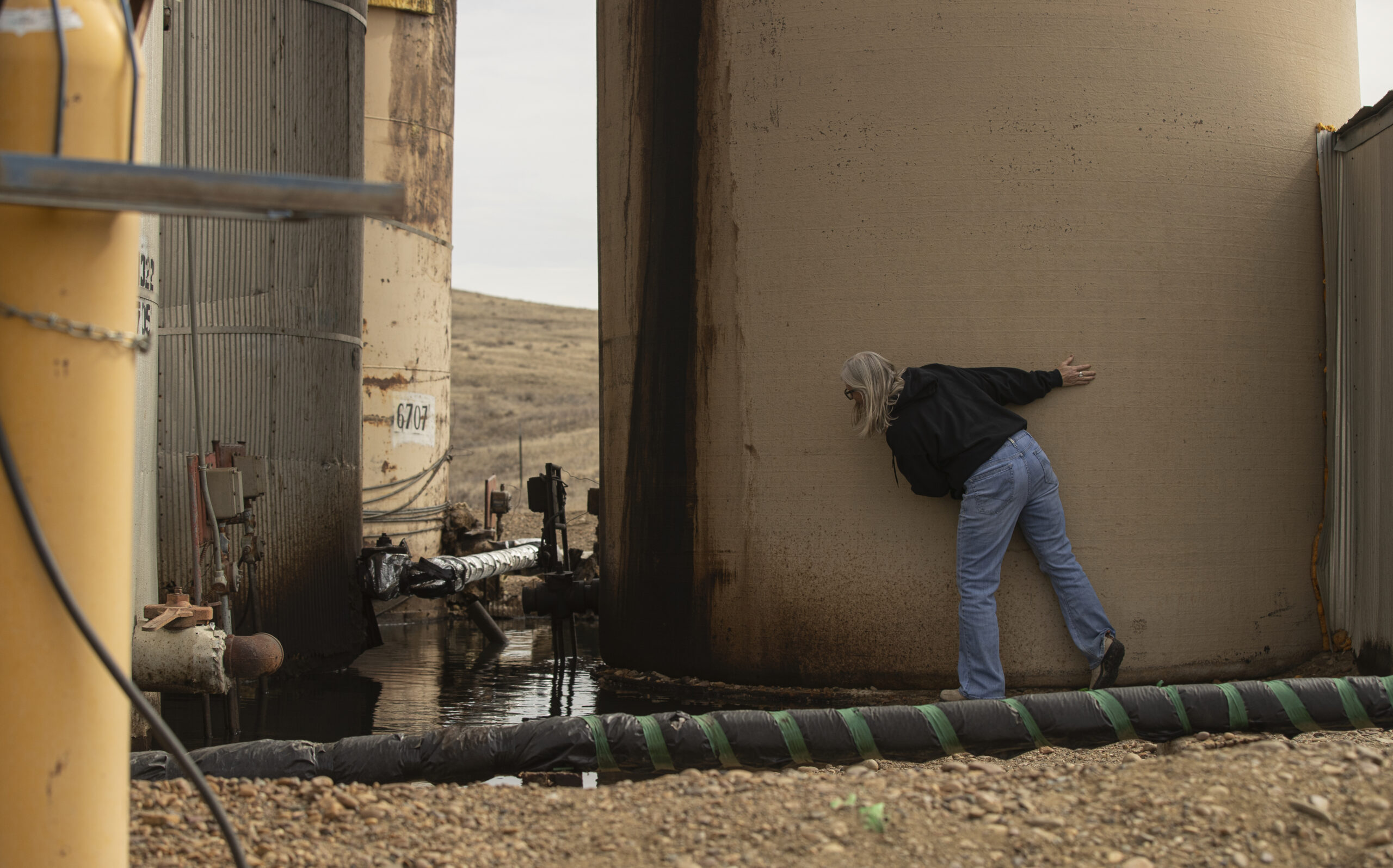
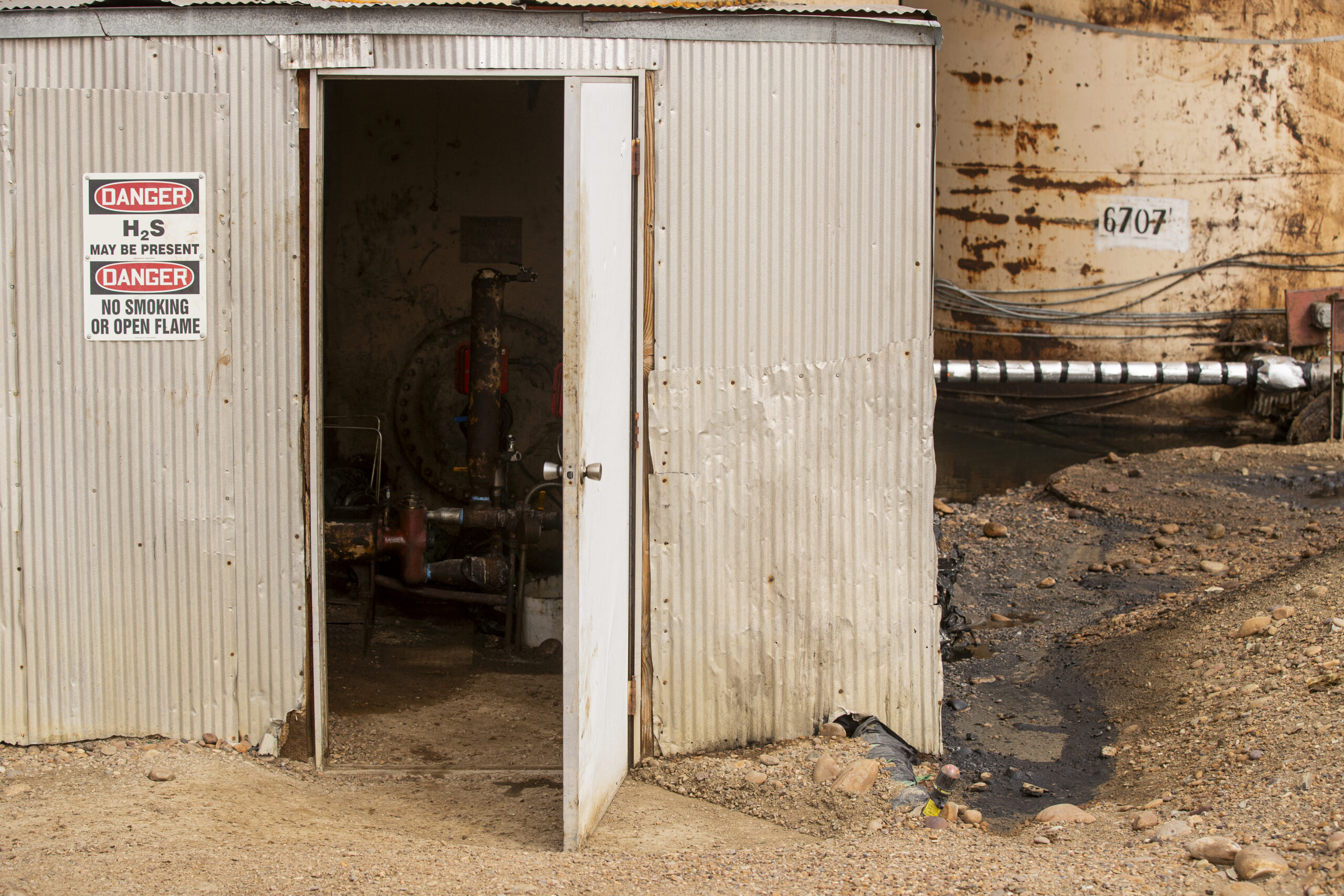
“Story of my life,” Madison said, with a blasé tone as she goes to work inspecting the small labyrinth of pipes and sheds. The smell of gasoline billowed from a thin layer of oil standing on top of the salty groundwater known as ‘brine.’
There was a steady stream of muddy brown water flowing into the pool from a leak in a white fiberglass pipe. A small amount of oil coated the top of the pipe with a thick, black, tar-like substance.
Madison shut off the well, causing the mechanical rocking of the rusty pump jack to slow to a halt. The sound of the flow of water dissipated.
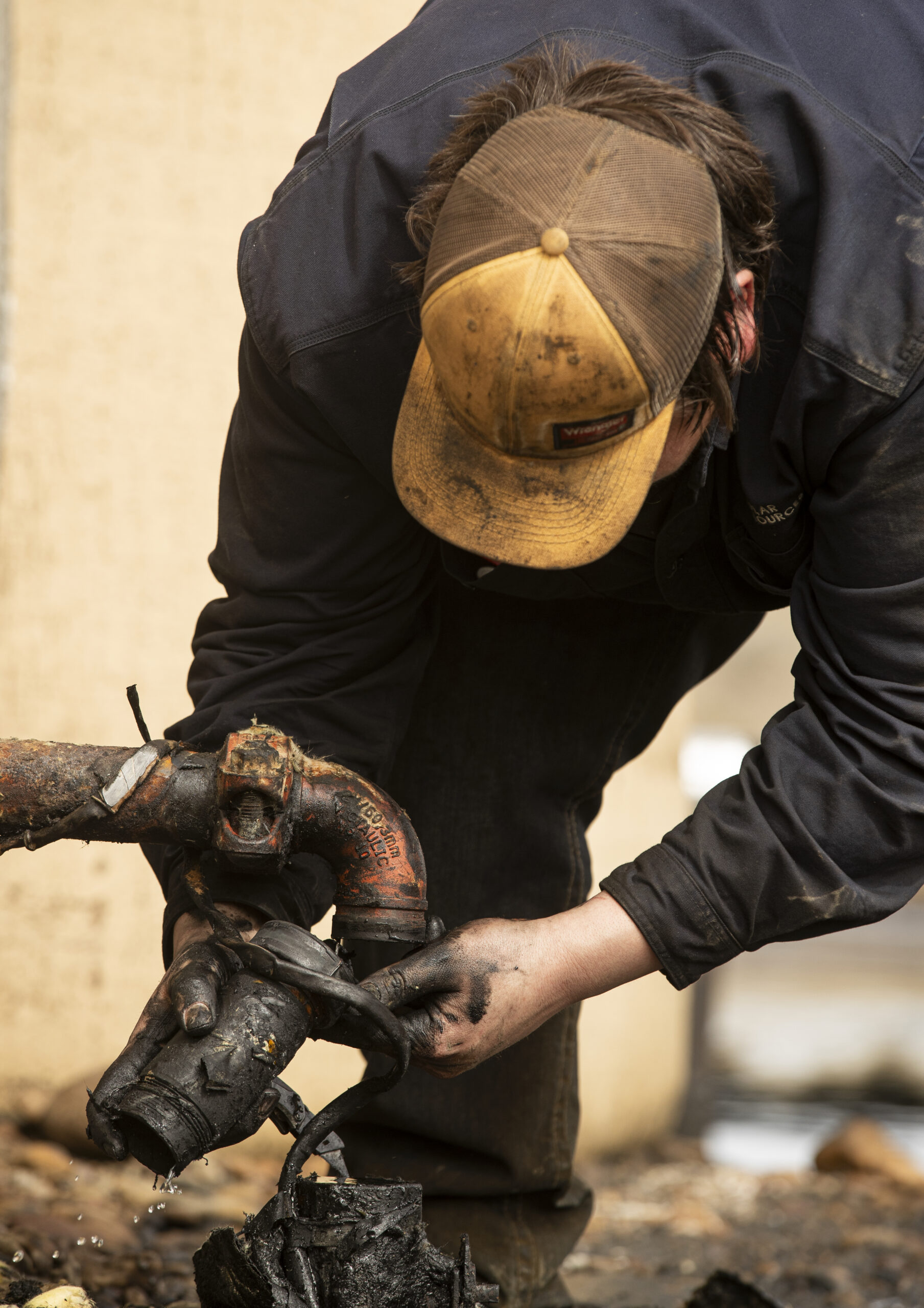
Soon, a truck arrived. Jordan Moran immediately got to work in the sloughy water. By the time the pipe was replaced, his hands, clothes and pants were stained black. Wiping them with old t-shirts donated by a local church did little.
Just across the border, in a booming North Dakota industry, workers are paid $45 an hour, employed with little vetting or oversight. Moran left that behind to return home where starting pay is $21 an hour, in line with the tribal wage scale. It’s hard to justify higher hourly rates when the rest of the reservation’s jobs pay so little.
Enlarge
After 75 years of successful drilling, oil extraction on the Fort Peck Indian Reservation has largely wound down. Recent explorations for expansion have proven unsuccessful while existing wells pump up an ever greater ratio of water to oil.
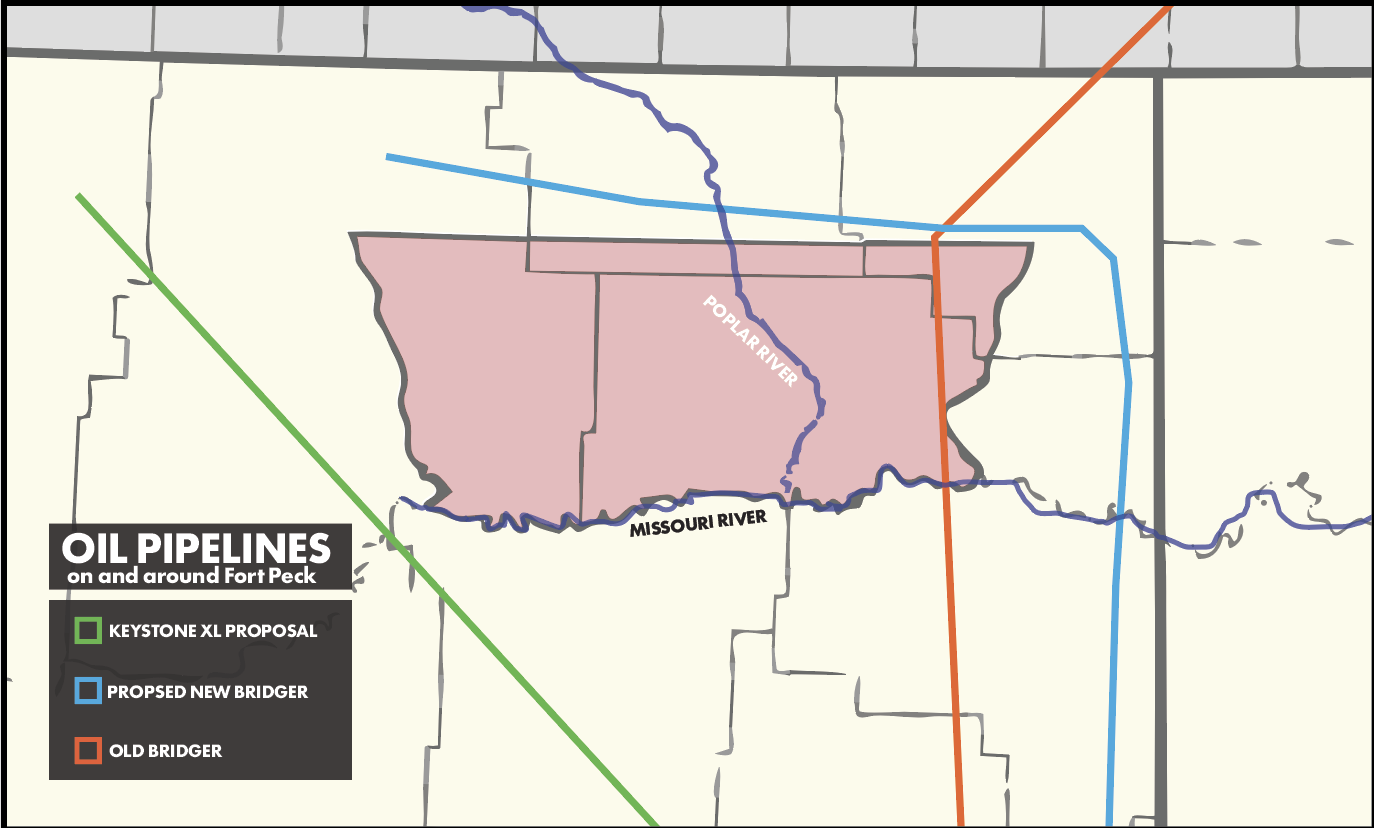
Tribes across the nation, including the Assiniboine and Sioux on Fort Peck, have become skeptical of the oil industry in which environmental disasters abound and the economic payoff rarely materializes. President Donald Trump’s “Drill, baby, drill,” campaign promise regarding energy policies have only emboldened oil companies. Now, Bridger Pipeline LLC, a Wyoming-based oil transportation company, is proposing a revival of the Keystone XL pipeline skirting directly around the reservation and running across the Poplar River.
Wary of further water contamination, the tribes are attempting to take a stand in a battle of David against Goliath. The proposed Bridger pipeline would bring about half a million barrels of crude oil from Alberta, Canada, through Montana and into Wyoming, nearly 650 miles of pipe. This project runs near the Fort Peck reservation and would cross the Missouri River downstream of its border. The risk to Fort Peck would be reduced, but not eliminated.
Still, the shadow of the previous project hangs over any future oil project. Specifically, the Poplar pipeline, which was also owned by Bridger, spilled about 40,000 gallons of oil into the Yellowstone River in 2015. Around the same time, Indigenous people from around the world voiced a unified stance against the Dakota Access Pipeline, which now delivers oil just north of the Standing Rock Indian Reservation in North Dakota.
Therefore, tribes are hoping future projects could be implemented with more consideration for Indigenous communities both environmentally and financially.
“I was kind of hoping that they were going to run it through the reservation so we can get the tax from it,” said Madison, referring to another proposal to route Keystone XL through Fort Peck. However, that project has since been rerouted. “Once they took it off the reservation, I just thought, ‘This is just like the Dakota Access Pipeline, right? There’s no benefit and all the risk.’”
More recently, the war in Iran, the partial closure of the Strait of Hormuz and the ensuing spike in oil prices have also strengthened the case for a pipeline, while not necessarily helping Fort Peck.
Enlarge

The Fear
Rick Kirn, a 16-year member of the tribal council and current chair of Assiniboine and Sioux Rural Water Supply Board, said the tribes’ concerns about the projects, even if placed out of reach of the Fort Peck water supply, is justified.
“Basically, any pipeline in this area, that’s what the tribes are against. Any kind of a disruption in it, or break in it, could be catastrophic,” Kirn said, adding that the tribes would receive no lasting benefits from its construction.
The Bridger pipeline would transport heavy Albertan crude, which persists in the environment far longer and has more adverse effects. According to Bloomberg, Bridger’s new $2 billion pipeline is slated to transport 550,000 barrels of crude oil a day.
“They say, ‘Well we’ve got control of [the potential pipeline].’ Well yes they do, but you stop and think of the pipe, the amount of crude oil that can go in a 36-inch tube and the length of it from the Poplar River, that’s a lot of crude,” State Rep. Frank Smith said, whose district includes a stretch along the southern border of Fort Peck. “So there’s a lot of questions about their safeties and our safety.”
A statement published by the Bureau of Land Management on April 1 stated it would consult tribal nations on a government-to-government basis. It also stated Indian tribal nations were invited to participate in the public input ‘scoping’ process. In a common theme with Keystone XL, none of the public meetings were on the reservation. Three tribal council members and the Tribal Historic Preservation Officer attend the closest meeting to Fort Peck in Glasgow, a two-hour round trip from the tribal capital in Poplar.
Enlarge
The Damage
Pertinent on many residents’ minds is the reservation’s past with oil companies.
Madison first began working for the Environmental Protection Office, the tribes’ equivalent to the U.S. Environmental Protection Agency, or the EPA, in the late ‘80s. A local resident came to her shortly after she began and asked if he could have a sample of his well water tested. It was drawn from the normally sweet aquifer north of Poplar that supplied 3,000 residents.
She used a simple device to measure the salt and mineral concentration of the water and was shocked by the pollution.
The tribal office got a grant and support from federal agencies to investigate further. After several years, the contamination was found to be caused by an expanding plume of brine water that had risen from oil drilling nearly a mile underground to the city’s shallow aquifer.
Brine water is essentially deep groundwater pumped up as a byproduct of oil. It’s generally separated out from oil and harmlessly pumped back underground where it can cyclically push up more oil. However, it’s also extremely salty, undrinkable and in some areas of Fort Peck, so acidic that residents couldn’t shower because it could burn their skin.
In total, roughly 40 million barrels of this brine water leaked into the aquifer over five decades.
The catastrophe was largely a result of a single, improperly sealed oil well with a poor concrete plug that was cracked by the vibrations of a nearby injection well. It took nearly two decades of investigation and legal proceedings to prove that the well belonged to Pioneer Natural Resources. In 2012, Pioneer and two other companies reached a settlement with the EPA.
Enlarge
For decades, the only water available for many was either bottled or boiled. The Assiniboine and Sioux Rural Water System, a multi-million-dollar federally funded project, was constructed to draw clean water from the Missouri with the last tribal members expected to receive clean water by the end of this year.
In the EPA settlement, the three companies paid a combined $320,000 dollars to the city of Poplar. They also had to provide bottled water to residents and pay for the construction of new water lines in the immediate area of the spill.
Wilfred Lambert, who took over as the head of the Office of Environmental Protection after Madison’s departure, estimates that there are approximately 900 abandoned ‘orphan’ wells on the Fort Peck reservation. This means their parent company cannot be found and they are out of operation.
The chances of the exact circumstances of the Pioneer’s leak happening again are low, but many wells are still waiting to be plugged with concrete at the cost of up to $100,000 in federal grants.
“I think that’s one of the reasons why they really like reservations, because we have ties to the federal government,” Kirn said. “They could come up with these super funds and whatnot [and] use them so they could get out of their responsibility.”
The bureaucracy
While Kirn said federal ties can make the reservation attractive, it comes with a number of caveats.
In its official proposal, Bridger stated that even though it provided a more direct route, it avoided crossing reservation boundaries because of potential permit challenges and delays from crossing multiple on-reservation and off-reservation tribal trust lands.
The reservation is split into a complex checkerboard of three types of land. Tribal and allotted land is held in trust by the federal government and requires approval from the Bureau of Indian Affairs to lease or sell. Fee land, also called deeded land, is owned directly by individuals and can be sold and leased without BIA approval. Roughly half the reservation is trust and allotted land while the other half is fee land.
Enlarge

“Well, it takes us about two years to get a permit to drill on the reservation when it takes two months to drill off the reservation [or] on deeded land,” Smith said. “So the oil companies have really stayed away from the reservation basically, except for deeded land.”
Federal cuts are slated to close a quarter of BIA offices, potentially slowing the process further. Conversely President Trump’s executive order “Declaring a National Energy Emergency” directs federal agencies to expedite projects.
The order was mentioned in the introduction of Bridger’s proposal, with the company estimating it would have all the permits required to start construction by July 2027. On April 30, Trump approved the presidential permit for the pipeline allowing the section of it crossing from Canada to the U.S. to be built. Additional federal and state permits will still be required.
Much of the fee land is owned by the third of the reservation’s population that are non-Natives who acquired ‘unused’ land as a result of the Homestead Act of 1862 or bought it after banks seized allotted land as collateral in the fallout of the 1887 Dawes Act.
Some are worried that Indigenous land owners still aren’t getting what their land is worth. Melvin “Terry” Rattling Thunder Sr. was a member of the tribal council for 14 years, including in 2012 during the start of land buybacks, which consolidated fractionated allocated land into direct tribal trust ownership.
He said the BIA was unwilling to show the tribes how they determine the mineral value under allocated land they are seeking to buy back. He worries that some were lured into selling their land for lump sums without realizing they were also selling their mineral rights and the far greater potential long-term income that could come from royalties.
In general, Kirn estimates the tribe and most landowners receive a lease deal equivalent to 1/6 of the gross revenue from oil wells on their land. This means if a well pumps up 600 barrels of oil, the landowners receive the full monetary value of 100 barrels, usually without any of the expenses being subtracted.
The boom and bust economy
Long-term income has proved elusive for the reservation, as Kirn estimates the vast majority of jobs provided by the potential pipeline’s construction won’t last longer than six months.
The Fort Peck oil industry as a whole has faded over the past few decades. Kirn estimates a peak of over 1,000 people working in it around the 1980s, while today, Madison estimated employment at less than 100. The reservation has a long history of wealth coming during the booms and leaving entirely during the bust in what some have dubbed a false economy.
The influx largely came via transplants raising rent and pushing out those with lower income jobs. Kirn said he started his own survey business in part because other companies wouldn’t hire tribal members.
Enlarge
A national effort was made to remediate this through the Indian Mineral Development Act of 1982, which included provisions for preferential hiring of Native Americans. Fort Peck and reservations across the nation soon created Tribal Employment Rights Offices to oversee this.
For a while this worked well, but bigger oil companies still preferred to bring in their own outside crews. Several outright left the reservation and others attempted to find loopholes.
“Supposedly, the owner of a company, they’d come in here and they’d hire [Native Americans] and pay them just a little bit of money, tell them ‘Go sit underneath the tree and just let us do our job,’” Kirn said.
In response, the tribes created a contractor’s association that companies had to consult to hire a pool of people that had already been screened. Kirn also clarified that preference isn’t the sole factor in determining who gets the job with candidates still having to be qualified. With the boom firmly a thing of the past, the contracting agency no longer exists, and the Tribal Employment Rights Offices is far smaller in size and scope.
The national debate
Jan Hasselman is a lawyer for the environmental nonprofit Earthjustice, which represented the Standing Rock reservation in a suit against the Dakota Access Pipeline.
Despite general success in challenging the permits for the Dakota Access Pipeline, Hasselman said the project was still pushed through and is unlikely to be shut down. Hasselman said the problems associated with oil on reservations are deep rooted and structural in nature, with the end result being oil companies socializing the cost and extracting the profits.
He suggested that oil companies should be required to put down more sure-fire financial assurance, equating to security deposits on the land that will be used in the event of environmental damage. At present, he said they use shell companies to avoid doing so.
With the inherent power imbalance of billion-dollar oil companies and individual reservations Hasselman thinks any legal fight against the pipeline will be difficult with construction likely going forward.
In the long term, he thinks America’s political compass will shift toward voting for more environmental policies and candidates which could make future legal battles far easier.
Fort Peck, into the future
Fort Peck has a unique history of legal acumen. The 1985 Fort Peck-Montana compact was one of the first reservation water rights settlements, guaranteeing the tribes a portion of Missouri’s flow. Groundbreakingly, in 2008, Fort Peck was again one of the first in the nation to receive direct control over its brine water pumping injection wells, a misuse of which was found to be one of the primary causes of the Pioneer well leak.
A different project has seen the worst of that brine water plume begin to get pumped out of the aquifer into emptied oil deposits a mile underground. Meanwhile, the water supply system created in the aftermath of the contamination of the aquifer meanwhile supplies 30,000 across northeastern Montana with clean drinking water from the Missouri River.
Lastly, statewide Held v. Montana (2023) found that Montana violated students’ right to a clean and healthy environment by passing legislation ignoring climate change. While Hasselman said it may not provide an answer due to it being hard to connect an individual pipeline to climate change, it could lay the groundwork to ask some of the right questions.
The future of oil itself still remains a contentious issue on Fort Peck with tribal chairman Floyd Azure acknowledging the good that can be done with taxation from it while still believing money is far from the end all be all. If a pipeline has to be built, he would prefer it not go through Fort Peck at all.
He grew up eating what he fished and hunted from the ranges and creeks on the northern side of the reservation, areas where even if the Poplar River runs lower and the percentage of fenced-in land is higher, the natural resources are still worth his efforts.
“Take care of the land and take care of what you got,” Azure said, referring to what his childhood taught him.
For all the problems that arrive on his desk daily, he said he believes he couldn’t have the life he’s made on Fort Peck anywhere else on Earth. It’d take a team of horses to drag him off the reservation, he said.
Floyd’s brother Howard works in oil with Madison, but if money was the end all for him, he and everyone else on Madison’s crew would be 100 miles east in North Dakota. The same regulations that pushed some companies out have kept a select few of the best and brightest here, vigilantly looking below and northward for whatever is to come.
A SPECIAL PROJECT BY THE UNIVERSITY OF MONTANA SCHOOL OF JOURNALISM
ADDITIONAL FUNDING SUPPORT FROM THE GREATER MONTANA FOUNDATION
READ MORE:
Previous
Veins of the River
Next
On The Border

